Introduction
Reading academic papers can be daunting. This guide simplifies the process.
Steps to Analyze
- Identify the main argument.
- Take notes on key points.
- Summarize findings in your own words.
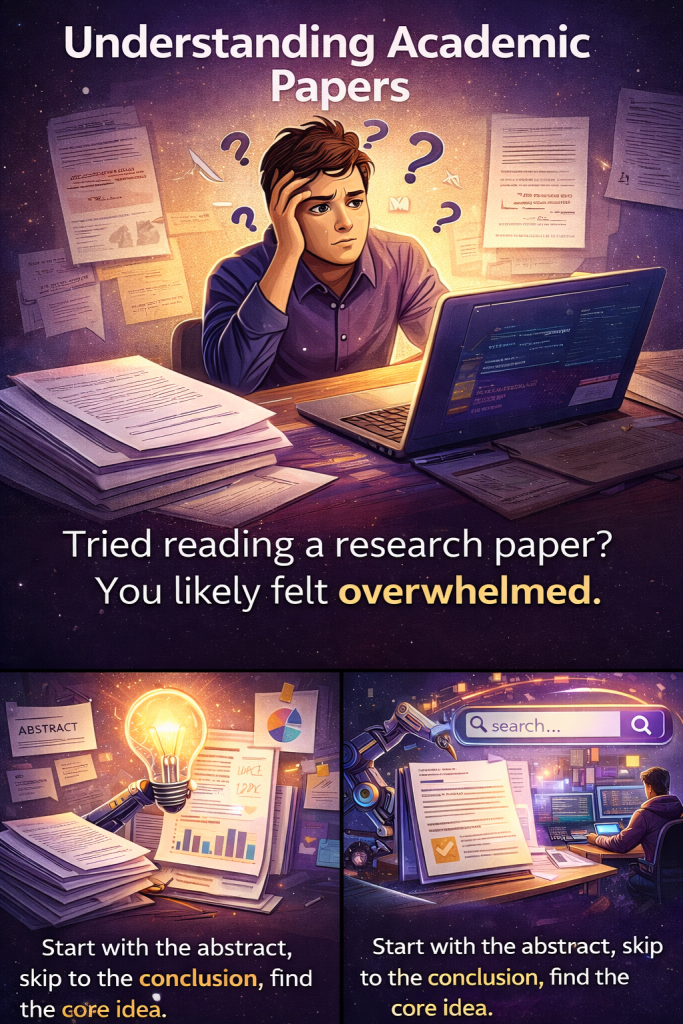
A practical guide for engineers who want to understand research without drowning in complexity.
If you’ve ever tried to read a technical paper, you probably felt overwhelmed. The text feels dense, abstract, full of unfamiliar terms, and often hard to follow from beginning to end. The truth is, this is a very common experience. Most engineers don’t struggle with the technology itself, but with the way research papers communicate ideas. And that’s exactly the gap this blog aims to solve.
The goal of The Tech Paper Review is simple: turn complex research into practical understanding. This is not about academic summaries or rewriting papers in simpler words. It’s about extracting the core idea, understanding why it matters, and connecting it to real-world applications.
At its core, an academic paper is much simpler than it looks. Every paper is essentially a structured explanation of a problem and a proposed solution. Everything else—math, experiments, charts, and technical details—exists to support that central idea. Once you realize this, reading papers becomes much less intimidating.
The biggest shift you need to make is in how you approach reading. Most people treat papers like textbooks, trying to understand everything line by line. That’s the wrong approach. Instead of asking yourself whether you understand every detail, focus on three questions: what problem is this solving, what is the main idea, and why does it matter. You don’t need full comprehension to get value from a paper.
A more effective way to read papers is to avoid reading them linearly. Start with the abstract to get a general sense of what the paper is about and what it claims. Then jump straight to the conclusion to understand what worked, what didn’t, and what the authors consider important. This alone can give you a surprisingly strong understanding of the paper without going through every section.
From there, your goal is to identify the core idea. Every impactful paper is built around a single powerful concept. For example, the Transformer introduced attention as a replacement for recurrence, GPT showed that next-token prediction at scale could generalize across tasks, and Kafka formalized the idea of a distributed log. Once you find that one idea, everything else in the paper starts to make sense around it.
One of the most important things to understand is that you don’t need to process every detail on the first pass. You can safely ignore most equations, experimental setups, and deep technical nuances initially. Focus on building intuition first. If needed, you can always go back later and dive deeper into specific sections.
Another critical step is translating what you read into real-world context. A paper only becomes truly valuable when you can connect it to practical use. Ask yourself where this idea is used today, what kind of problem it solves in production systems, and whether you would apply it in your own work. If you can answer those questions, you’ve already achieved meaningful understanding.
There are a few common mistakes that make reading papers harder than it needs to be. Trying to understand everything is one of them, and it often leads to frustration. Getting stuck on mathematical details too early is another, especially since math is usually there to validate ideas rather than introduce them. Reading passively without questioning the content also limits how much you actually learn.
Great papers tend to share a few characteristics. They usually introduce a simple but powerful idea, scale effectively, and apply to multiple use cases. This is why papers like GPT, Dynamo, and MapReduce became so influential—they each introduced a concept that extended far beyond their original context.
In the end, academic papers are not difficult because they are inherently complex. They are difficult because they are not written to teach; they are written to prove. Once you understand this difference, reading papers becomes much easier and far more productive.
Going forward, this blog will break down important papers across areas like artificial intelligence and distributed systems, focusing on the problem they solve, the core idea behind them, how they are used in the real world, and what has aged well or poorly over time.
If you remember one thing, let it be this: you don’t need to understand everything in a paper. You just need to understand the idea that matters.